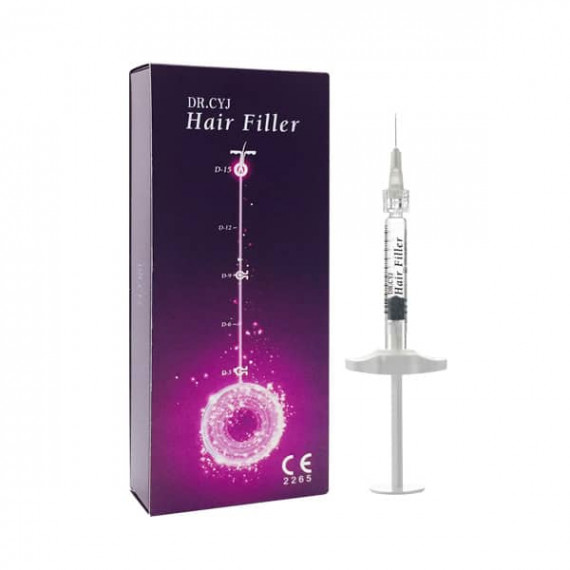
DR. CYJ Hair Filler
Injectable hyaluronic acid and biomimetic peptide scalp filler for professional hair loss and scalp rejuvenation protocols, manufactured by Caregen Co., Ltd (Seoul, South Korea) — the same manufacturer as Dermaheal HL. A pre-filled 1 ml sterile injectable gel combining 0.70% hyaluronic acid in PBS with a patented complex of 7 proprietary Caregen peptides (Decapeptide-28, Octapeptide-2, Oligopeptide-71, Decapeptide-18, Oligopeptide-54, Decapeptide-10, Octapeptide-11). CE-marked Class III Medical Device (CE 2265). No exosomes. Developed over 13 years of Caregen R&D; launched 2016.
Product category note: DR. CYJ Hair Filler is a CE-marked Class III Medical Device and an injectable hyaluronic acid + biomimetic peptide scalp filler. It contains no exosomes. It is in a different product category from the exosome-based hair products on this site. It is included as a complementary professional scalp injectable used alongside or as an alternative to exosome scalp protocols.
CE Class III Medical Device (CE 2265 — EU only). No FDA clearance. DR. CYJ Hair Filler contains no exosomes. For professional use by qualified healthcare practitioners only. Verify regulatory status in your jurisdiction before use.
What Is DR. CYJ Hair Filler?
DR. CYJ Hair Filler is manufactured by Caregen Co., Ltd, the same Korean company that produces Dermaheal HL. Where Dermaheal HL is a multivitamin mesotherapy cocktail with 56 active ingredients, DR. CYJ Hair Filler is a precision injectable: a hyaluronic acid gel scaffold (0.70% HA) loaded with 7 Caregen-proprietary biomimetic peptides, delivered in a sterile 1 ml pre-filled syringe.
The HA provides the gel matrix and scalp hydration carrier. The 7 peptides are Caregen's proprietary sequences, each targeting a specific aspect of hair follicle biology: stimulating microcirculation, strengthening hair shaft structure, activating follicular stem cells, and supporting the dermal papilla environment. The low-viscosity formulation penetrates to the scalp dermis; the prolonged-release design allows gradual delivery of the peptides after injection rather than a single bolus.
DR. CYJ Hair Filler holds a CE marking as a Class III Medical Device (CE 2265) in the European Union. Class III is the highest risk tier for medical devices in the EU regulatory framework — these devices require a notified body assessment and clinical data before market clearance. This is a different regulatory category from cosmetic products or cosmeceuticals, and gives DR. CYJ Hair Filler a distinct professional positioning compared to every other product on this site.
Indicated for: non-scarring alopecia (androgenetic, areata, and other types), scalp damaged by chemical treatments or physical trauma, pre-operative scalp preparation before hair transplant, and post-transplant recovery support.
Regulatory note: DR. CYJ Hair Filler is a CE-marked Class III Medical Device — this is an EU regulatory classification only. It does not carry FDA clearance or approval in the United States. Practitioners must verify the regulatory status and applicable rules for the use of CE-marked medical devices in their specific country before use. For professional use by qualified healthcare practitioners only.
Caregen Co., Ltd — DR. CYJ vs Dermaheal HL
Caregen Co., Ltd (founded Seoul, 2001) manufactures two products in the Exosome Korea hair range. Both use Caregen's biomimetic peptide technology and contain no exosomes:
Formulation & Product Characteristics
CE Class III Medical Device — CE 2265
Class III is the highest-risk tier in EU medical device regulation, requiring notified body assessment and clinical safety/performance data before market clearance. DR. CYJ Hair Filler's CE 2265 certification reflects this rigorous pathway. The strongest regulatory credential of any product on this site within the EU.
7 Proprietary Caregen Peptides in a Patented Complex
Decapeptide-28, Octapeptide-2, Oligopeptide-71, Decapeptide-18, Oligopeptide-54, Decapeptide-10, Octapeptide-11. Distinct from the Dermaheal HL peptides. Each targets a specific aspect of follicular biology: scalp microcirculation, hair shaft strengthening, follicular stem cell activation, dermal papilla support, anagen phase prolongation, anti-miniaturisation, and anti-inflammation.
0.70% Hyaluronic Acid — Gel Scaffold + Prolonged-Release Depot
The HA provides both the injectable gel matrix and scalp hydration. The PBS carrier ensures physiological pH and isotonicity. Low viscosity allows clean intradermal delivery; the prolonged-release mechanism delivers the peptides gradually after injection, extending the therapeutic window between sessions compared to standard mesotherapy solutions.
Pre/Post Hair Transplant Indication
One of the few products on the site with an explicit pre- and post-hair transplant indication. Pre-operative use prepares the scalp environment; post-operative use supports graft take and scalp recovery.
Scalp Damage Indication
Indicated for scalp damaged by chemical treatments (bleaching, colouring, perming), physical trauma, and external aggressions. This positions DR. CYJ for patients presenting with treatment-related alopecia — a common but under-addressed presentation in aesthetic clinic settings.
Caregen Co., Ltd — Founded 2001, Seoul
Caregen is also the creator of Aquashine (skin biorevitaliser) and the Dermaheal range. DR. CYJ is their premium medical device injectable brand, distinct from the Dermaheal cosmeceutical line.
The 7 Caregen Peptides — What Each One Does
HA: 0.70% in PBS (phosphate buffered saline), sterile gel, low viscosity, prolonged-release formulation.
Peptide complex (all Caregen-proprietary sequences):
Formulation note: Peptide identities confirmed from Laboratoire Caregen official documentation, moryskin.com, and topdermal.com. Specific mechanisms based on Caregen's published data. Full clinical evidence should be confirmed with Caregen manufacturer documentation before professional communication.
How DR. CYJ Hair Filler Fits Professional Practice
DR. CYJ occupies the most defined clinical niche of any product in this range: a CE-cleared structured injectable scalp depot for non-scarring alopecia, scalp damage, and transplant support. It functions standalone or as the HA-scaffold peptide component of a combination approach with exosome products and/or Dermaheal HL.
Best-Fit Use Cases
- •Non-scarring alopecia (androgenetic, areata)
- •Scalp damaged by chemical or physical trauma
- •Pre-hair transplant scalp preparation
- •Post-hair transplant recovery and graft support
- •Standalone injectable scalp rejuvenation
- •Combination with exosome products or Dermaheal HL
Related Treatment Contexts
- •Dermatology and trichology clinical settings
- •Hair transplant surgical adjunct protocols
- •CE medical device-grade scalp treatment programmes
- •Caregen brand workflows (DR. CYJ + Dermaheal HL)
- •Combination with PRP for growth factor augmentation
- •Practitioners requiring medical device documentation
How Clinicians Use DR. CYJ Hair Filler
Intradermal Scalp Injection — Primary Protocol
30G or 32G needle. Insert at approximately 30° to the scalp surface, targeting superficial or middle dermis. Apply consistent pressure on the plunger for uniform distribution. Low-viscosity gel spreads evenly to form a structured peptide-releasing depot. Apply topical anaesthetic cream prior if required.
Pre-Hair Transplant Protocol
Applied to the recipient zone in the weeks before surgery. Prepares scalp environment: stimulates microcirculation, improves follicular health, reduces scalp inflammation that could compromise graft take.
Post-Hair Transplant Recovery
Applied post-operatively to support graft integration, reduce surgical scalp inflammation, and maintain follicular environment during recovery. One of the few products in this range explicitly indicated for this use.
Combination Protocols
Compatible with Dermaheal HL (same manufacturer), exosome scalp products, and PRP in same session or alternating schedule. DR. CYJ provides the structured HA depot and precision peptide payload; Dermaheal HL provides broad nutritional coverage; exosome products provide cellular communication payload.
Standard protocol: 1 session every 2–4 weeks, course of 4–6 sessions. One 1 ml vial per session. Results typically visible at 2–5 months into the course. Always follow the Instructions for Use (IFU) provided with the product.